
Love Bundle, Part II
Scholastic Romance

When I spend time with fellow academics lately, I notice that we seem dour and down, filled with doom and disappointment – and for good reason. Our sphere has been hit hard. You don’t need me to count the ways. But these are our lives, our schools, our purposes. I want us to rediscover hope, weave connections, and feel joy.
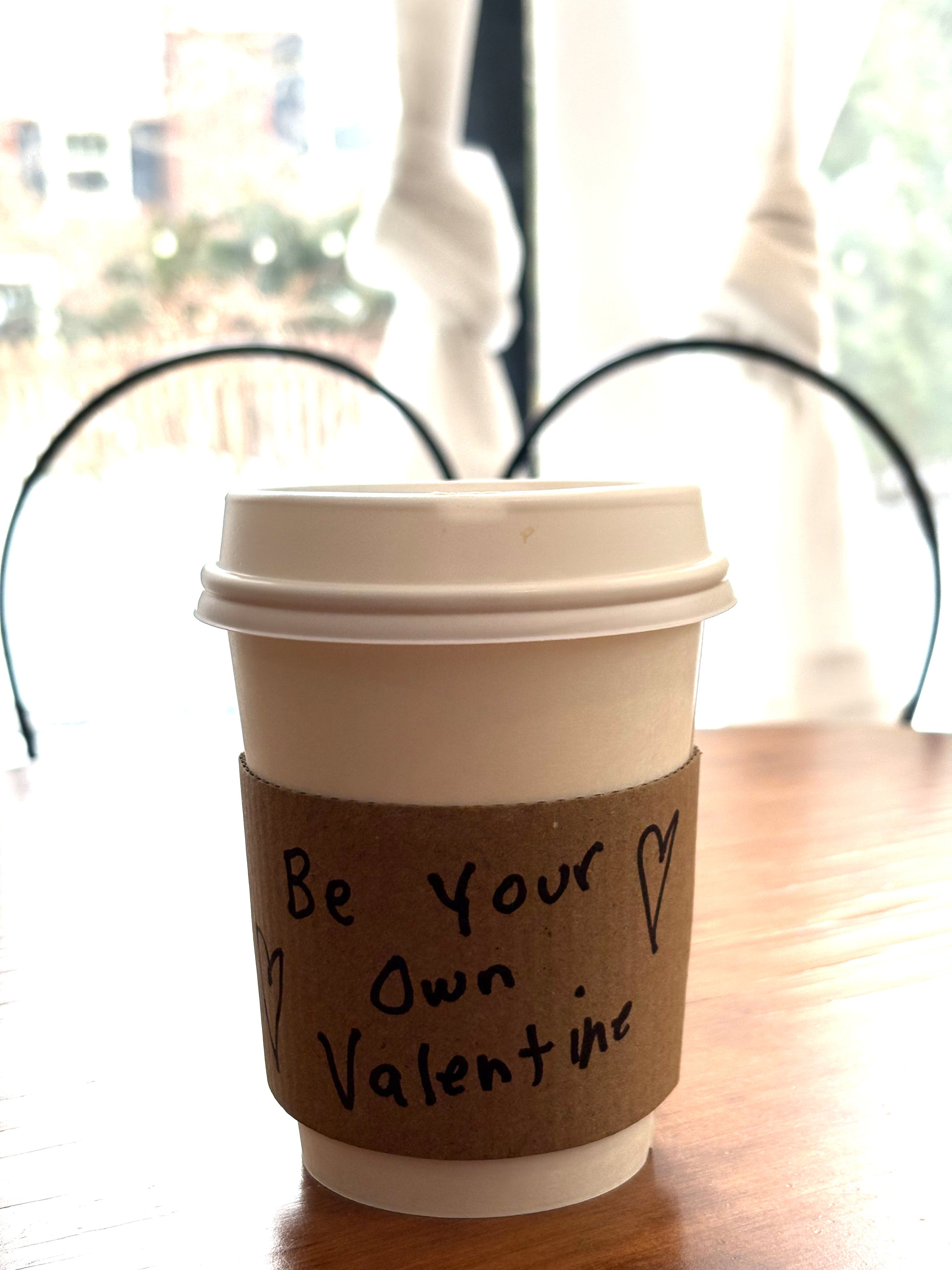
Last summer, while listening to the Shelf Love podcast, I heard one of the voices say that romance is the “hope-iest” genre. I’m trying out the thesis by embracing scholastic romance, a subgenre of romance fiction that I’m making up, because scholars need love too. What is scholastic romance? All the love stories you’ve read set on campuses, in libraries and museums, at research sites and university or independent presses, and featuring scholar-researcher-explorer-librarian-teacher-scribe-type characters. In other words, all the stories that might appeal to academic lonely hearts. If you’re a romance reader (secret or otherwise) and would read lists or reviews of books like these, please let me know in the comments (or the other ways that you reach out to me).
Here’s the whole Valentine’s Day story from Love Bundle Part I, written by Alyssa Napier, the illustrator of Camp Dissertation. Enjoy!
Words Apart
By Alyssa Napier
A note from Alyssa: Today, university presses publish a wide variety of books that target readers beyond academia, including poetry, comic books, original fiction, art books, memoirs, and more. But in the 1970s, university presses began experimenting with publishing commercial books for a more general audience. Back then, Black students (inspired by the Black Power and Black Arts Movements) were demanding that colleges, especially HBCUs, be more connected to the wider Black community and change their curriculum away from the standards and values of white academia. These demands led to the development of Black Studies. In this story, the fictional Maynard University Press asks similar questions as Black students at the time: What does a Black university press owe the Black community outside of academia? How do we maintain our place in academia by adhering to standards that were developed to exclude us? These are questions that many Black academics still grapple with today.
I decided to write a romantic meet-cute because the world is bleak right now, especially for those of us in higher education, and romances can provide brief moments to be playful and optimistic.
1
“Theo Hughes hates me.”
Lena Tate’s tendency toward theatricality was well-known to all Maynard University Press staff, so she couldn’t blame her office mate and fellow editor Andrea Louder for not looking up from the manuscript she was marking.
“He basically called me a race traitor,” Lena went on, taking a seat at her desk. She placed the strap of her leather bag over the back of her chair and fished out her notebook. She opened it to the page with notes from her meeting with Professor Theo Hughes, Maynard University’s latest assistant professor hired to the newly formed Black studies department. The only notes she’d taken were today’s date and the word “HATE” etched so deeply with her pen that it was embossed on several pages afterwards.
Andrea continued looking at her manuscript as she replied, “What did he actually say?”
Lena tried to think back to the words Theo had actually used in between his sneers of contempt. “I told him the kinds of books I was looking to publish, and he told me to go straight to hell, do not pass GO, do not collect $200.”
Andrea laughed and finally looked up at Lena. Andrea was a dark-skinned woman with straightened shoulder-length hair swept into feathery layers. She had big brown eyes and full lips usually painted a sensible dark neutral color. Andrea’s staple wardrobe of dark colored button-downs and brown slacks contrasted with Lena’s eclectic assortment of brightly patterned dresses, skirts, and blouses. Lena had brown skin, and her hair was always teased into a voluminous afro.
Lena and Andrea had joined Maynard University Press, the first and only press at a historically Black university, around the same time. From the moment they sat down at desks opposite each other, they had been inseparable, despite their dramatically different approaches to editing. Lena preferred flashy, risky projects that challenged what university presses would typically publish. Her audience were activists, artists, feminists—anyone deeply embedded in the vibrant Black radical movements of the 1970s. Andrea published traditional scholarly monographs that garnered strong reputations in academia. Theo probably would have preferred it if Andrea had knocked on his office door to ask him to join Maynard University Press’s faculty board instead of Lena.
Lena leaned over her desk to peek at the manuscript Andrea was working on, and, as expected, the first few sentences she read made her eyes glaze over. University libraries ate up Andrea’s books. But Lena wanted her books in the window displays of radical Black bookstores that hosted spoken word nights and political education book clubs. And for this Theo Hughes had called her a race traitor.
“Okay, fine, what he actually said is that he thought the books I want to publish would make people take Maynard less seriously as a research institution. As though a book of feminist poetry or a collection of photographs of the Black Power movement are going to tarnish the reputation of the best HBCU in the country.”
Andrea tilted her head.
Lena glared. “You think he had a point.”
Andrea looked to the side.
“So now you think I’m a race traitor, too?”
Andrea rolled her eyes. She capped her pen, likely realizing that she was not going to get any work done until Lena’s tantrum was over. “I do not think you’re a race traitor. And neither does Professor Hughes. But it’s possible that he’s right about our reputation. None of the white presses are publishing poetry. None of the white presses are tying themselves up with the movement.”
“Isn’t the point that we’re not like the white presses? Why should we follow their lead?”
“Because they control the academic standard.” Andrea gestured to the manuscript in front of her. “All of my corrections are geared around making this manuscript meet the expectations of white gatekeepers in academia. And that’s what my authors want. That’s what the Maynard administration wants. To not be seen as automatically intellectually inferior just because we’re an HBCU. To compete on their level.”
“Well maybe I don’t want to compete. Maybe I want to change the game. People around us are reimagining what society could be. Why not be part of that?”
“Is that what you told Professor Hughes?”
“Something like that.”
“I take it he declined the offer to be on the faculty board, then.”
Lena dropped her face into her hands. “Unfortunately, he accepted. He said he would be honored to help steer the press in the right direction!”
The faculty board met once a month to approve all book projects for contract. Faculty members rotated off the board after three years, and Lena was devastated that the time had finally come for Nikki Walker, the previous Black studies professor on the board, to leave. Nikki shared Lena’s vision about expanding the target audience of Maynard’s books beyond academia. When Nikki recommended that Theo Hughes replace her position on the board, Lena had assumed Nikki’s approval meant Theo shared their values.
But no. Now Lena had invited the judge, jury, and executioner into her own house. Theo’s first faculty meeting would be next week. Theo had said he was excited to attend, with a barely perceptible smile that revealed dimples Lena would have found cute if they hadn’t been flanking a mouth that had just questioned what she found most meaningful about her career. “I look forward to reviewing your projects, Ms. Tate.”
Lena had less than a week to figure out how to make her books palatable to stuffy, snobby, pretentious Theo Hughes.
Or, alternatively, she had less than a week to make him see things her way.
2
“Why are we here?” Theo looked worryingly at the building where Lena had asked him to meet her. The three-story slice of brick had once been part of a rowhouse, but the two houses on either side of it had been demolished. The house that remained looked like it was barely keeping itself upright without its friends. The brick facade was crumbling, the stone steps looked as supportive as dust, and one of the street-facing windows was covered in a black trash bag that fluttered in the fall wind.
“Thank you for coming,” Lena said, with a strained smile, using the affectation she donned with particularly difficult authors. This version of Lena was not threatening to fragile egos or masculinities. She had even decided to dress more like Andrea today, wearing a dark brown vest over a light blue maxi dress. Sure, the maxi dress was patterned with protest slogans, but Lena could never completely dull her shine, even if her future at Maynard was on the line.
The faculty board meeting was on Wednesday. Today was Saturday, meaning she had less than five days to convince Theo to not blanketly reject anything she was submitting. She didn’t need him to be as enthusiastic as Nikki had been, she just needed him not to try to turn the other five faculty members against her. Per the bylaws, the faculty board technically didn’t need unanimity to accept projects, but they tended to defer to their colleague’s concerns.
Theo wore a crisply ironed white button-down under a charcoal gray herring-bone blazer and brown corduroy pants. He adjusted his tortoise shell glasses while looking at the house as though this slight tweak might make it look any less like his final resting place. Lena rolled her eyes.
“You’re not in danger. When they tore down the house on the right, the drug den relocated.”
At Theo’s raised eyebrows, Lena laughed. “I’m just kidding. We’re perfectly safe. This is a Panther neighborhood. They take care of us.”
Lena expected some Black conservative snark about the Black Panthers being a domestic terrorist organization that set back the Black cause, but instead Theo repeated, “Okay, I trust you.”
Lena was surprised taken aback. She searched his face for signs of sarcasm, but he just looked at her intently as though waiting for her lead. A little uncertain at the unexpected vote of confidence, Lena began walking up the steps and motioned for Theo to follow her.
The outside of the building belied the immediate coziness of the inside. Rugs competed for dominance on the hardwood floors of the entrance hallway. The walls were lined with vibrant art pieces of different colors, dimensions, moods, and textures. Lena inhaled a combination of incense and simmering meats flavored with peppers and thyme. She heard shouting followed by raucous laughter coming from the room at the end of the hall. Lena looked behind her to see Theo’s reaction. She thought she caught a glimpse of those dimples again, a hint at a smile, but it was gone too quickly.
Before they got to the end of the hallway, they were greeted by a fat, almond skinned Black woman whose curls were piled atop her head and held in place by a silver and purple scarf. She wore a green house dress under an apron with a Black power fist on it. She embraced Lena, and her hair smelled like the promise of something fried.
“My girl!” Eugenie said with a Jamaican accent. “Welcome, welcome. And who is this?”
Theo stuck out his hand. “Theo Hughes, professor of Black studies at Maynard Uni--”
Before he could finish, Eugenie had enveloped him in a hug. “My brother! Welcome to Kuumba House!”
Theo’s arms dangled uselessly at his sides before raising to pathetically pat Eugenie on the back. Eugenie didn’t seem to notice his ambivalence. When she broke her embrace, she took Lena’s arm and guided her to the living room. “Everyone else has arrived. As you can hear, the book has already sparked much debate.”
“Is Larry pissed?”
“Big mad.”
“I know I’ve done my job right if I’ve published something that pisses Larry off.” Eugenie and Lena pressed their foreheads together and cackled.
The living room was a circus of at least three separate conversations, two of which seemed to be screaming matches. Lena took her usual blue love seat with silver threaded paisleys in front of a coffee table.
“Have you read the book?” Eugenie asked Theo, gesturing to an open seat on a couch next to Lena’s chair. He sat, sharing the couch with a Chinese American woman in a striped jumpsuit arguing with a Black man whose bell-bottomed legs were draped across her lap.
“I’m afraid I haven’t. I wasn’t given much information.” Theo’s eyes flicked to Lena, and she grinned. This was even more fun than she thought it would be.
Theo seemed completely out of his element, but had enough home training to try to accept his surroundings, even if he couldn’t exactly mirror the frantic energy. As Eugenie fetched tea for Lena and coffee for Theo, Theo leaned across the arm of the couch toward Lena.
Because he had to get close enough for her to hear him over the din of the living room, Lena was able to see, for the first time, how beautiful his dark brown eyes were behind his glasses. He had a long nose that flared into broad nostrils, and his lips were naturally pink. He was, unfortunately, very attractive. Lena had a fleeting vision of cupping his square jaw in her hand, but he thankfully interrupted her delusions by speaking.
“So this is a book club?” he asked.
“We read books here, sure. But that’s only part of our political practice. Eugenie helps to run the Black Panther breakfast program. Jane and Kwame,” Lena gestured to the couple fighting next to Theo, “are co-chairs of the Afro-Asian Solidarity Collective.” She went around the room introducing the wide range of activist work represented here, not even trying to keep the pride out of her voice.
With each introduction, Theo nodded, his expression unchanging, and Lena was disappointed he wasn’t at least a little ashamed that he had assumed these kinds of people weren’t a worthy target audience for Maynard University Press books.
“And what book are we reading?” he asked. Lena was surprised at the use of the word “we,” as though Theo felt part of this even though everything about him screamed COINTELPRO plant.
Lena picked up a bright pink book on the table and handed it to him. When he took it from her, the tips of their fingers brushed, and her stomach flipped.
“Hysterical Sistahood,” Theo read.
“One of my books. Maynard published it a couple of months ago. It’s an essay collection about Black women’s experiences with their reproductive system. From first period to menopause and beyond.”
Theo flipped to the table of contents. He frowned. “None of these contributors are academics.”
Lena glared at him. “The introduction was written by a professor at Smith. But the contributions are from all kinds of Black women.”
“Black women academics are a kind of Black woman,” Theo said, and Lena wanted to scrub from her memory that she ever thought this man was attractive.
“Obviously, I know that,” Lena said. “What I mean is—”
Eugenie came back with their tea and coffee and clapped her hands together to signal that it was time for group conversation. As the group began to talk about what they learned, what resonated with them, what questions emerged, and what made them angry, Lena felt like she was in church. There was holy rapture in hearing the ideas that she had helped contain in ink and paper flourish to life in banter, debate, and snaps of solidarity.
She couldn’t help but steal glances at Theo, but his poker face was stubbornly strong and he kept quiet. He looked at each speaker as they talked, his eyes ping-ponging back and forth during particularly frenzied discourse. He occasionally nodded. At one point, he opened his briefcase, pulled out a notepad and pen, and began taking notes. But his jottings were staccato, too short to be interpreted as disagreement, assent, or what. There was no non-obvious way for Lena to strain over her the gap between their seats to peek, so she made a mental note to plan a briefcase heist later.
At one point, there was a precious rare lull in the conversation, which Lena leapt to take advantage of. “What does our Black conservative think?” Lena took a sip of her black tea as though it was an innocent question, but looked over the mug at Theo pointedly.
Theo looked around the room, then realized that everyone was waiting for him to speak. “Me?” he asked. “I’m not a conservative.”
“Then why are you stopping our Lena from publishing books like this?” Eugenie asked, waving her paperback copy in the air.
Theo’s eyebrows raised over the tops of his glasses frames. “There must be a misunderstanding. I just joined the faculty board. I haven’t even attended a meeting yet. I haven’t stopped Lena from doing anything.”
Lena placed her mug down on the coffee table with such quick fury that a little bit of it spilled. “You told me Maynard’s reputation would suffer from publishing these kinds of books. If you had been on the board, would you have approved it?”
“I haven’t read the book, so I can’t make a judgment call about its academic merit.”
“Screw academic merit, what about the fact that it connects with readers? Don’t you want to be a part of publishing books that have this effect on people?” Lena gestured to her lively, colorful friends.
Theo stood up, his expression having finally shifted, but into something Lena still couldn’t read. He turned to Eugenie. “Thank you for having me, but I should be going now. I had a great time.” As he left, Lena’s stomach plummeted.
“You should probably go salvage what you can of your job,” Larry said. “I don’t want to start paying for books.”
Lena hurried after Theo and managed to catch up with him at the bus stop at the end of the street. God bless the city’s inconsistent public transportation giving her a few spare minutes to try to make amends.
“I’m really sorry,” Lena said.
“No, you’re not.”
Lena rolled her eyes. “Fine, I’m not. But while we’re at work, can we pretend that I am? So I don’t lose my job?”
Theo took his glasses off and wiped his face with his hand. “You brought me there to embarrass me.”
“What? No! I brought you there to see the kinds of people I think Maynard has a duty to reach. There is a Black reading public that is eager to discuss big ideas, just not how they’re packaged for academia.”
Theo put his glasses back on and looked at Lena. “Why did you think I was a conservative?”
Lena wanted to say, Because you called me a race traitor for wanting to publish poetry, but then she remembered that he had never actually called her a race traitor. “Because you think books for readers outside of academia will hurt Maynard’s reputation.”
“They will. They already have. I’ve spoken to scholars who say they do not want to publish with Maynard University Press because they want their books to be taken seriously. Not because they hate poetry, but because they want to get hired at institutions that have certain expectations about what kinds of books should be next to theirs in a publisher’s catalog. If we publish books like Hysterical Sistahood, we foreclose ourselves from publishing leading scholars. Recognizing that isn’t conservatism.”
“No, but giving into those expectations is.”
Theo shook his head. “Why are you working at a university press if you think academics are conservative for caring about their careers?”
“I value knowledge as much as any academic. I just think it can come from and flow to anywhere.”
Theo’s face pinched together. “Lena,” he said, and it was the first time he had used her first name, which caught Lena off guard. He seemed to notice that as well, as he corrected himself. “Ms. Tate. I don’t disagree with you on that point. You seem to think I don’t value the kinds of books you publish simply because I recognize the harm that they do to our academic reputation. I think there is great political work to be done from within the academy. But in order to do that work, we must remain within the academy. White academia will use every excuse to delegitimize our work. The scholars I mentioned who would rather publish with Harvard, Yale, or Princeton? They would love to publish with Maynard. Some of them are Maynard or HBCU alums. But if we are forcing them to choose between their careers and their community commitments, they will choose their careers. Do you understand that?”
On the face, Theo’s words sounded patronizing. Lena worked with Black academics, so of course she understood the conditions under which they labored, needing to be twice as good for half as much. She was also a Black woman in academia, though on the other side of the desk. But she knew, from the pained expression he had finally allowed her to see and the vehemence in his voice, that Theo wasn’t lecturing her. He was opening up to her. He spoke in the third person, but he was talking about himself.
Lena reached out to place a hand on his arm. “I understand,” she said.
She heard the exhausted sigh of the bus as it rounded the corner. Theo seemed to watch the bus amble to the stop with sadness, but then his face morphed back into a blank expression.
“This is for you,” Lena said, handing him the copy of Hysterical Sistahood he’d left behind. “A perk of being on the faculty board. Free books.”
Theo nodded, took the book, and boarded the bus.
3
Lena stared down at her index cards that contained her talking points for the faculty board meeting. But every time she tried to read what she had written, her eyes crossed as though protecting her from the futility of her presentation. She knew Theo would reject any project she presented.
After the book club on Saturday, Lena tried to will into existence a letter from Nikki begging for an unprecedented fourth year on the board. Alas, when Lena walked into the conference room, she saw Theo sitting where Nikki had sat for three previous years. He was talking to another faculty board member, a silver-haired Black woman in the education department. Lena took note that he was stone-faced with her as well. Lena wondered how often Theo opened up to anyone the way he had, even briefly, on Saturday night. His momentary vulnerability had felt so ephemeral, she could have convinced herself she’d made it up if she hadn’t been missing her copy of Hysterical Sistahood.
Regardless, Lena hadn’t managed to persuade him to believe in her vision for expanding the range of Maynard University Press books. If anything, she may have even pissed him off more. It was hard to tell.
When she took her seat at the conference table, on the opposite end from where the faculty members held court at the front of the room, he caught her eye briefly. Another unreadable expression. Or just an unfamiliar one. What kind of smile was that? A smug, I-have-all-the-power smile? An apologetic sorry-in-advance-for-ruining-any-chance-of-making-your-signing-goals-this-year smile? Or a category she hadn’t yet seen in their brief time knowing each other?
There were only three editors at Maynard’s small press, and because they presented in alphabetical order, Lena always went last. She watched with a little envy as her colleagues stood to present their straightforward, risk-averse projects. All Maynard projects had to be peer-reviewed, and usually the faculty members saved themselves time by trusting the peer reviewers’ recommendations. Unless the peer reviewers raised objections, they rarely pushed back, especially on the books with obvious contributions to an academic field.
But there was a new member on the board, and he was doing things differently. Instead of the perfunctory approval process the editors and faculty board were used to, Theo wanted to deeply engage with the substance of each project. The other faculty members looked annoyed, and Lena caught the political science professor checking his watch at least three times while Theo gave comments on one of Andrea’s books. But Lena watched Andrea and the editorial director come alive under Theo’s thoughtful questions. He didn’t interrogate to intimidate; his scrutiny felt like genuine curiosity and a generous desire to see the projects become the best they could be. He had written extensive comments on each of the printed packets, which included the book proposal, peer reviews, author response to reviews, and sample chapters.
Theo took what they did very seriously, and even though Lena knew he was going to excoriate her, she couldn’t help but feel grateful that he cared enough about Maynard University Press to devote so much of his time to each book. They may fundamentally disagree about the mission of the press, but Lena knew that disagreement came from a passion for doing what he thought was best for the race that she recognized in herself.
Finally, Lena’s turn came. She had brought only one. She’d decided to delay the rest of the projects she’d originally had on this month’s docket until she could get on Theo’s good side (or for whatever passed as his good side). But this project was being shopped around to other presses, so she needed approval as soon as possible to close the deal.
Lena shuffled her index cards before standing up.
“This book is a collection of letters from jail written by someone who has made a career out of getting arrested during protests. Over four decades and a dozen causes, Carol Ali has written hundreds of letters, which have been collected, curated, and annotated by her and her daughter Karen, who is primarily the person she was writing to. Karen never wrote back, because she was angry with her mom for prioritizing her activism over her maternal responsibilities. They were estranged for a long time, but recently reconnected and decided to embark on this project together to heal themselves and serve as a model for anyone else experiencing either side of prison bars.” Lena took a deep breath. “Neither of these women is an academic, but Carol’s letters and Karen’s annotations reveal the wisdom gained from their lived experiences and honest reflections, which I think is just as valuable, and in some cases more so than what a scholar may write about second hand.”
The last sentence was not on Lena’s index cards, but she wanted to pre-empt Theo’s likely criticism. And she whole-heartedly believed that Carol and Karen had knowledge that was worth putting the full weight of Maynard University’s legacy and reputation behind. If she was going to lose this project, she wanted to pull out all the stops.
There was a brief silence before the chair of the faculty board, a white professor of chemistry named Arlo Thorsson cleared his throat and said, “Well, that seems like a reasonable project to me. Solid peer reviews. I say we approve, so we can make it out of here before sunset.”
The room chuckled, and Lena felt a moment of relief before hearing Theo’s voice interrupt.
“Actually, I had one comment.”
Lena’s throat went dry. “Go for it,” she said.
Theo’s eyes remained on his stack of pages as he spoke. “I agree with you that there is profound wisdom here. I also think that the analysis could be sharpened by incorporating some insights from Dr. Claudia Chisholm’s latest monograph, The Imprisoned Womb, an ethnographic study on the experiences of incarcerated Black mothers. You might want to recommend that Carol and Karen read it to connect their personal reflections to what other women in similar circumstances have expressed.”
Lena waited for more. She looked at Andrea who shrugged. She looked at the other faculty members, but they, too, seemed confused that the man who had given what felt like a lecture of comments for each previous project had nothing more than a book recommendation.
“Is that… it?” Lena asked
Theo finally looked up at her, and she finally had an interpretation for the hint of a smile he had given her earlier. It wasn’t smug or apologetic. It was an acknowledgment of the connection they shared. He nodded.
“So you approve?” Lena asked, her voice breathy with disbelief.
Theo nodded again, then looked to Arlo, who had started dissociating the moment Theo had started talking. The woman beside Arlo nudged him, and he jolted awake. After remembering where he was and what he was meant to be doing, Arlo concluded the meeting, and everyone filed out, glad to be free of the one hour meeting that was never supposed to have taken the full hour.
Lena and Theo both lingered behind, an unspoken agreement that there was more speaking to do. Lena pretended to organize her index cards as an excuse to stay, but Theo just folded his hands on the conference table and looked at her expectantly until everyone had left.
“Thank you for approving my project,” Lena said, surprising herself that she managed to sound sincere. Because—also a surprise—she was.
“It’s a good project.”
“But it’s exactly the kind of thing you said was dangerous for Maynard to publish. So what changed?”
Theo began running one thumb across the fingers of his other hand, and Lena realized she was slowly learning how to interpret him. He was so tightly wound and revealed so little, but if you knew where to look and how to read, his emotions were clear as day. This was Theo Hughes being nervous. And it was kind of adorable.
“I didn’t like how you saw me. When you called me conservative, I thought it was obvious that I wasn’t. But going to Kuumba House and reading Hysterical Sistahood helped me see that you were right. I’m holding on so tightly to the pillars of legitimacy because Black studies doesn’t have that yet. We had to fight to get the field into universities, and it’s so young, we’re still not taken seriously by other disciplines. You may think I’m conservative, but to white academia, I’m a rebellious laughingstock. I feel constantly on the defensive. And I let that get in the way of seeing how valuable the work that you do is. Black studies came out of the movement, and we can’t turn our back on that energy just so that we can be accepted in these institutions that may never accept us anyway.”
Lena felt a hint of the man at the bus stop again, and she loved knowing he felt comfortable enough with her to drop the blank expression he wore that masked his passion. Even if it made him nervous. Lena offered him a soft smile.
In return, she saw his dimples again.
“Well,” she said. “If you can admit that, I guess I can admit that you’re right, too. I probably underestimate how difficult it is for Black scholars to jump through the right hoops to stay in academia. But the work y’all do is important. I could work for some other press, but I wanted to work at a university press specifically because I believe in the value of scholarly work. Not only that, but I believe in the value of bringing academia and art and activism and creative expression together into something beautiful and messy and unexpected and accessible for all kinds of Black folk.” Lena interlaced her fingers together and then yanked them apart, spreading her arms out, while mimicking the sound of an explosion.
Theo laughed. It was the first time she had heard him laugh, and she didn’t expect it to be so loud, to reverberate straight through to her bones. That kind of laugh would fit right in at Kuumba House, she thought.
“We’re having another book club this Saturday,” Lena said. “We’re reading Marsbound, a science fiction epic in which Martians wipe themselves out with a planet-wide death cult and bequeath their planet to Earth’s Black diaspora.”
Theo winced. “Did Maynard publish that?”
Lena laughed. “If I say yes, are you going to take back what you said about me being right?”
Theo smiled. Watching him, Lena realized she was looking forward to hearing him laugh again and being the reason why.
I recommend the scholastic "romantasy" novels that include a professor of the history of science at Yale, an Oxford sabbatical, a medieval manuscript at the Bodleian Library, alchemy, a friend with a MacArthur, upstate New York, genetics, the sixteenth century, an unlikely love match (so much more!) and.... vampires, witches and demons: Deborah Harkness's A Discovery of Witches and several sequels. Deborah Harkness is herself a professor of the history of science (emerita). I was a doubter until I wasn't. Fantastic books! (in more ways than one)